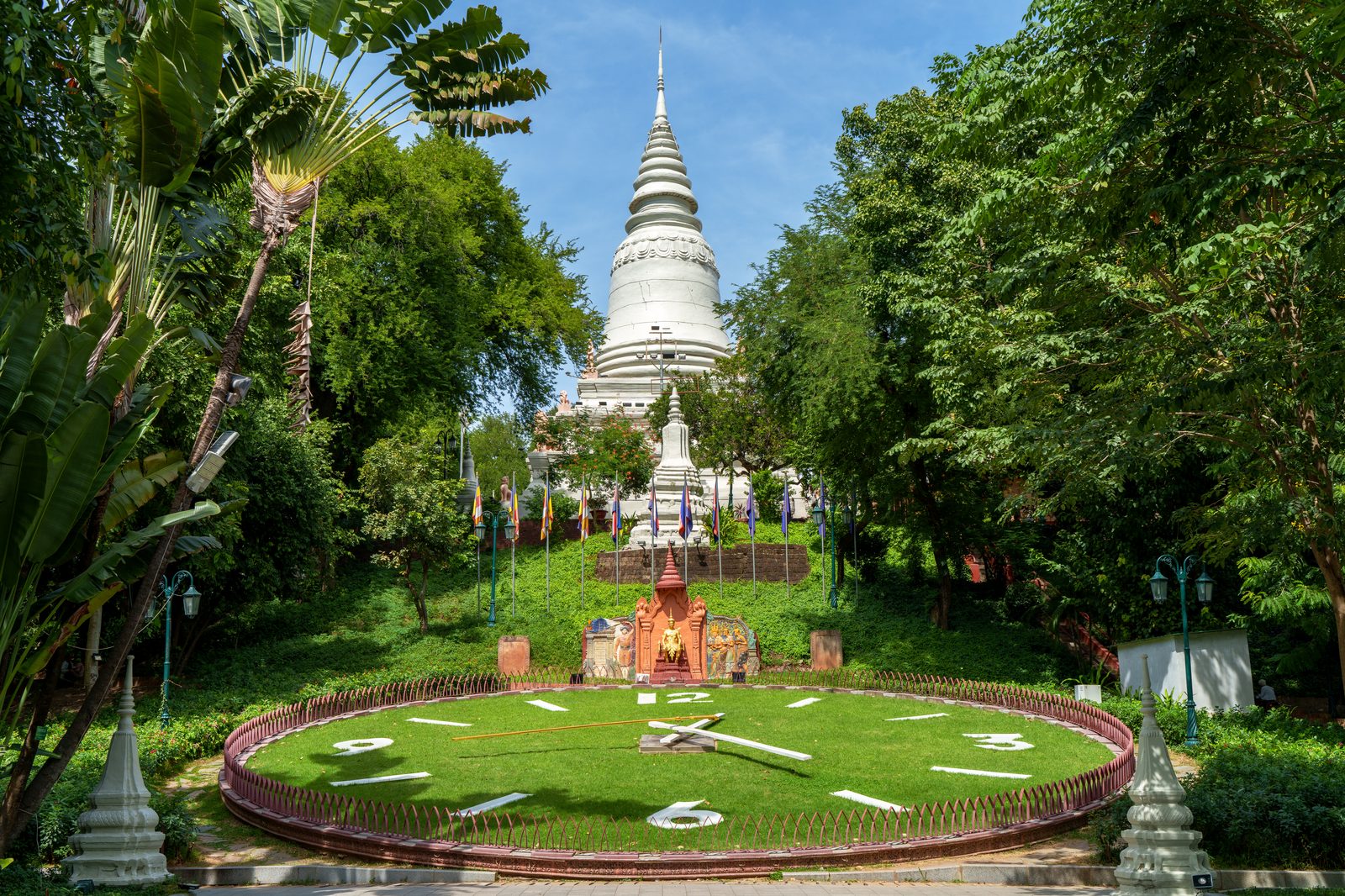
Wat Phnom Daun Penh - main view in Phnom Penh, Cambodia

វត្តភ្នំដូនពេញ

Wat Phnom Daun Penh(Phnom Penh)

One of Phnom Penh's most iconic historic Buddhist landmarks, perched on a hill above the city center.

វត្តភ្នំដូនពេញ · /vɔət pɲom/

4.4 · 9,562 Google reviews

Rating and review count synced from Google Maps user reviews · September 2026 · See all reviews on Google Maps ↗

TypeBuddhist temple
LocationPhnom Penh, Cambodia
Hours07:00 – 19:00
Visit30–60 min
Current status
Local time (Phnom Penh): --:--

📥 Download 1-min offline pocket guide (PDF)

A sacred tree, five statues, the birth of a city. In 1372 the wealthy widow Lady Penh (Daun Penh) found a drifting Koki tree on the Tonlé Sap riverbank; within it lay four bronze Buddhas and one stone Vishnu. She led her neighbors to mound the earth into a hill and enshrine the relics — and Phnom Penh ('the hill of Penh') was founded, with Wat Phnom as the spiritual heart of the millennium-old capital.— The legend of Lady Penh

About

About Wat Phnom Daun Penh

Wat Phnom Daun Penh is one of Phnom Penh's most famous historic temples, sitting atop a small hill in the city center. It is both an active Buddhist site and a cultural landmark tied to the very origin of the city's name.

Welcome to Wat Phnom Daun Penh, widely recognized as the central Wat Phnom. Located in the heart of Phnom Penh, Cambodia, this destination serves as a primary hub for travelers visiting the region.

Type

Buddhist temple

Location

Phnom Penh, Cambodia

Rating

4.4 (9,562)

Hours

07:00 – 19:00

Why it's worth a visit

  • The birthplace of the legend behind Phnom Penh's name
  • A living Buddhist temple still busy with devotees
  • City views from the hilltop
  • Khmer art, murals and sacred relics

Visitor tip

Plan your visit

The hilltop is compact and easy to combine with other central Phnom Penh sights.

  • Allow 30–60 minutes for a relaxed visit
  • Dress modestly when entering the temple
  • Pair it with the riverfront and Royal Palace area
  • Go early for cooler weather and fewer crowds

History & Culture

History & Significance of Wat Phnom Daun Penh

From a 14th-century legend to the spiritual heart of Phnom Penh.

1
14th century

The legend of Lady Penh

A wealthy widow, Lady Penh (Daun Penh, 'Grandmother Penh'), found four bronze Buddha statues — and one stone Vishnu — hidden inside a drifting Koki tree on the riverbank. She summoned her neighbors to mound earth into a hill (phnom) and enshrine the relics in a wooden shrine. The act gave the city its name: Phnom Penh, 'the hill of Penh'.

2
1431

Capital moves to Phnom Penh

King Ponhea Yat relocated the Khmer capital from Angkor to Phnom Penh. He rebuilt Wat Phnom and raised a great white stupa (chedi) on the summit to house his ashes. The humble hill shrine was elevated into a royal spiritual center.

3
15th–19th c.

A growing sacred hill

Across centuries the shrine was repeatedly rebuilt and enlarged. The artificial hill became the focus of local faith, and the surrounding settlement gradually grew into today's capital.

4
19th c.

French Protectorate care

Under the French Protectorate, successive kings restored and expanded the temple. The stupa and vihear (prayer hall) took on the later Khmer restoration style still seen today.

5
1926

Hébrard's restoration

The renowned architect Ernest Hébrard led a major restoration during the colonial period, shaping the classic silhouette of Wat Phnom that visitors recognize today.

6
Modern

Symbol of the capital

Today Wat Phnom stands as a national cultural emblem and the namesake hill of Phnom Penh, welcoming devotees and travelers from around the world.

Legend

The founding legend of Lady Penh

The tale of Lady Penh and the drifting Koki tree is Phnom Penh's best-loved origin story. Inside the tree she found four bronze Buddhas and a stone Vishnu — a quiet sign of how Cambodian Buddhism blended with earlier Hindu devotion. The mound she raised became the hill, and her shrine became the temple that still gives the capital its name.

Audio guide

The legend of Lady Penh

Hear the 14th-century story of how a drifting Koki tree gave the city its name.

Audio narration coming soon

Architecture

Khmer Buddhist architecture

A layered hilltop sanctuary: stupa, shrines, murals and sacred trees.

Central stupa

The tall white stupa enshrines sacred relics and marks the spiritual center of the hill.

Buddha images

Revered Buddha statues — including those tied to the founding legend — are enshrined within the vihear.

Vihear murals

Painted in the early 20th century, the hall murals depict the Buddha's Jataka tales woven with scenes from the Khmer epic Reamker (Ramayana). Look up: the ceiling shows a cosmic mandala and the pillars are sheathed in gold.

Khmer ornament

Naga balustrades, lotus motifs and carved lintels showcase classic Khmer craftsmanship.

Seven-headed Naga stair

The dramatic stairway guarded by a seven-headed naga (serpent) symbolises the rainbow bridge linking the human world to the cosmos (Mount Meru) — a stairway to the heavens.

Sacred tree & shrines

Shaded trees and Lady Penh's small votive shrine dot the hilltop, lending a calm, contemplative atmosphere.

Hilltop layout

The man-made hill lifts the temple above the streets, offering a quiet overlook of the city.

Preah Chau Shrine

On the hill's north side stands the Chinese sanctuary (Preah Chau), where Khmer, Chinese and Vietnamese folk faiths meet. Merchants and students come to pray for wealth, success in studies, or draw a fortune stick (kien).

Experience

What visitors can do

A short but fulfilling stop for culture, calm and city views.

Visit the temple

Observe local devotion in the vihear and learn about daily Buddhist practice.

Enjoy the city view

Overlook central Phnom Penh from the hilltop.

Photograph the details

Great for architectural and cultural photography — stupa, murals and ornament.

Feel local life

Watch residents come to pray, make offerings and seek blessings.

Suggested routes

Recommended routes: half day & full day

Two ready-made routes matched to the time you have.

Half day

Half-day route (3 hours)

About 3 hours · Low intensity

A compact route for travellers with limited time: straight up to the temple, around the hilltop, then back down past the landmarks that gave the city its name.

  1. 07:00
    Arrive at the foot of the hill

    Enter from the main stairway on Wat Phnom Road. If you would like to make an offering, incense and flower garlands are sold at the entrance.

  2. 07:20
    Climb the main stairway

    The wide eastern stairway is the classic approach — the naga balustrade and the avenue seen from above are the signature view.

  3. 07:40
    Hilltop temple and stupa

    Walk clockwise around the central sanctuary, then visit the small shrine of Lady Penh, the figure behind the city's name.

  4. 08:30
    Pond and memorial terrace

    Descend slowly, then circle the pond at the base and the memorial on the eastern side for a calmer view of the hill.

  5. 09:30
    Coffee or breakfast nearby

    Continue on foot towards the riverside or the central market district, where many cafés and local eateries open early.

Best for a first visit, a layover or a travel day with a fixed departure — you can be back in the city centre within three hours.

Full day

Full-day route (7 hours)

About 7 hours · Moderate intensity

A route that puts the temple back into the context of the old city: hill, old market, royal palace, national museum, and a riverside finish.

  1. 07:00
    Sunrise and the hilltop

    Start with the coolest hour: temple, stupa and the hilltop panorama before the coach groups arrive.

  2. 08:30
    Breakfast stop

    Local breakfast shops and cafés sit within a short walk of the hill — noodle soups, coffee and fresh fruit.

  3. 09:30
    Old market and heritage streets

    Explore the surrounding streets: colonial-era shophouses, art-deco market buildings and the city's historic trading quarter.

  4. 11:30
    Royal Palace & Silver Pagoda

    A 15–20 minute walk or a short ride south reaches the palace complex, the most important royal site in the country.

  5. 13:00
    Lunch and rest

    Take a long, air-conditioned lunch break during the hottest part of the day.

  6. 15:00
    National Museum

    Khmer art and sculpture, a few minutes from the palace and a useful complement to the iconography of the temple.

  7. 16:30
    Riverside and sunset

    Finish along the Tonlé Sap and Mekong promenade as the light softens over the water.

Best if you want to see the temple in the context of the historic city centre — visit the hill first, then let the day flow south and east towards the river.

Walking times assume a relaxed pace with photo stops. Tuk-tuks and ride-hailing apps are widely available if you prefer to shorten any leg.

Tailored plans

Three routes tailored to how you travel

Pick the plan that matches your group and your pace.

Families with children

1.5–2 hours · gentle

A short, low-pressure visit built around the stairway, the open hilltop and the pond, with plenty of shade and seating.

  • Climb the main stairway in short stages — there is room to stop on every landing.
  • Hold children's hands on the stone steps, which are worn smooth in places and slippery after rain.
  • Keep to the hilltop and the pond terrace; skipping the western side keeps walking distances short.
  • Carry water and a hat, and use the shaded benches at the base for breaks.

Best before 09:30 or after 16:30 — cooler, quieter and easier on young children.

Photographers & nature lovers

2.5–3.5 hours · flexible

A light-driven plan that follows the best angles on the hill and through the surrounding greenery.

  • Early morning gives soft side light on the eastern stairway and mist among the trees.
  • Late afternoon brings warm light onto the temple façade and the city skyline beyond the hill.
  • The tree canopy around the base is the most productive area for birds and squirrels.
  • Compose the naga balustrade, the stupa spire and the avenue below as your three signature frames.

Rainy-season afternoons add saturated greens and reflective stone — worth the trip if you can dodge the heaviest downpours.

Low-mobility & step-free visiting

1–1.5 hours · minimal walking

A plan for visitors who prefer to avoid long stairways, using the gentler approach and the manageable parts of the site.

  • A paved access road winds up the eastern side of the hill with a much gentler gradient than the stairs.
  • The plateau at the top is level and can be explored without climbing further steps.
  • Seating and shade are available at the base of the hill and around the plateau.
  • If you use a wheelchair or have limited stamina, ask staff or your driver to approach from the upper road.

Arriving by vehicle close to the plateau removes almost all of the climb; mornings are the quietest and coolest window.

Best time to visit

When to visit Wat Phnom

The hilltop is open daily; each part of the day has its own mood.

Time of day

Morning Best for calm

Cooler and quieter — a peaceful time for photography and prayer.

Afternoon Best for light

Warm, directional light — good for capturing architecture and murals.

Evening Best for atmosphere

As the lights come on, the hilltop feels especially atmospheric at day's end.

ⓘ Busiest mid-morning and on weekends; go early for a quieter experience.

Live conditions

Weather at Wat Phnom & 7-day outlook

Current conditions on the hill and what to expect over the coming week — check before you set out.

Now

29°C

Light drizzle · Feels like34°C · 32° / 25°

Rain chance
94%
Wind
13 km/h · Force 3
Gusts
33 km/h
Humidity
83%
UV index
2.3
Visibility
6.5 km
Sunrise
05:49
Sunset
18:01

Updated16:15 · refreshed automatically about every 30 minutes

No weather alerts today — plan your visit as usual.

What to wear

  • Rain is around — a water-resistant jacket and quick-drying clothes are the practical choice, with non-slip shoes for the stone steps.
  • Hot today — light, breathable clothing works best, and the day-to-night difference is small.

What to do

  • Passing showers — outdoor stops may be interrupted; keep the plan flexible and go up the hill between showers.
  • Stone steps and paths stay slippery after rain — take the stairway slowly and use the handrail.
  • High temperatures — avoid the midday peak, shorten time on the open hilltop and take shaded or indoor breaks.
  • UV is strong — plan the climb before 10:00 or after 16:00 and rest in the shade at midday.

What to pack

  • An umbrella or a compact rain jacket
  • Sunscreen, sunglasses and a sun hat
  • Plenty of drinking water
  • Tissues or wet wipes

Next 7 days

  • TodayThunderstorms94% 32° / 25°
  • WedRain showers96% 33° / 25°
  • ThuThunderstorms100% 32° / 26°
  • FriThunderstorms100% 32° / 25°
  • SatThunderstorms94% 31° / 25°
  • SunThunderstorms95% 31° / 25°
  • MonThunderstorms100% 30° / 25°

Seasonal strategy

When to visit: seasonal strategy table

Weather, water and wildlife combined across Cambodia's three seasons.

Wat Phnom sits on a low hill in central Phnom Penh, where the year divides into a cool dry season, a hot dry season and a monsoon season. The table below brings three dimensions together — climate, water conditions and wildlife activity — so you can match your visit to the conditions you actually care about.

Season Weather & climate Water & site conditions Wildlife & vegetation Visiting strategy
Cool dry season November – February Best overall The most comfortable window of the year: daytime highs around 30–32 °C, nights near 21–23 °C, low humidity and the least rainfall. Early mornings can bring light mist over the hill. Water levels sit at their annual low, so the pond and riverside channels are calmer and clearer and the panorama from the hilltop is at its most open. Egrets, mynas and the temple squirrels are active in the canopy, and the bodhi and banyan trees stay green — the most reliable window for birdwatching and photography. First choice for a first visit. Both the half-day and full-day routes work well; go early morning or late afternoon, and expect the busiest crowds between 09:00 and 11:00.
Hot dry season March – May Go early The hottest stretch of the year: afternoon highs of 35–38 °C, strong UV, and occasional convective showers or thunderstorms late in the day. Levels are low, the surface drops and the chance of algae growth and turbidity rises. Treat water features as scenery only and avoid contact. Activity shifts to dawn and dusk, with very little movement at midday. Flowering trees attract more insects and bees during this period. Ascend only between 07:00–09:30 or after 16:30. Carry sunscreen and water, keep hilltop time short, and stay clear of trees and lamp posts when a storm rolls in.
Monsoon season June – October Lush & quiet The southwest monsoon brings heavy rain, peaking between July and September, usually as intense afternoon downpours. Paths turn slippery and humidity often stays above 85%. The Mekong and Tonlé Sap rise markedly and water features refill, turbidity increases, and short-term surface ponding is possible during the heaviest rain. After rain, frogs and insects are active in the temple grounds and birds gather in the understorey. Vegetation is at its greenest — the best stretch for rich, saturated imagery. Bring rain gear and non-slip footwear and plan around the afternoon storms. Stone steps are most slippery 30–60 minutes after rain, so hold the handrail; mist and wet stone make this a strong period for photography.

This combined assessment covers three dimensions — climate, hydrology and ecology. Climate context follows the 30-year climate normals (1991–2020) published by NOAA and the Ministry of Water Resources and Meteorology of Cambodia (MOWRAM); water and ecological observations reference public material from the Ministry of Environment of Cambodia. Conditions vary from year to year — treat this as planning guidance, not a forecast.

Getting there

How to reach Wat Phnom in Phnom Penh

Wat Phnom sits in central Phnom Penh, easy to reach from most parts of the city.

The hill is near the junction of Norodom Boulevard and Street 96, a short ride from the riverfront and the Royal Palace.

Tuk Tuk

The most common way to get around Phnom Penh.

  • Flexible for short trips
  • Fares vary by distance and time
  • Agree on the price first

Taxi / Ride app

Good for families and hot weather.

  • Metered taxis and ride apps available
  • Good for groups with luggage
  • Drop-off near the hill entrance

On foot

Walkable from the central riverfront area.

  • About 15–20 min from the riverfront
  • Flat, mostly shaded streets
  • Combine with a riverside stroll

From the airport

Phnom Penh International Airport (PNH) to Wat Phnom.

  • About 10 km / 25–40 min by taxi or ride app
  • Fixed-price airport taxi at the rank
  • Tuk tuk also possible in good weather

Practical info

Visitor Services & Nearby Facilities

A neutral, type-only reference for planning your visit — facilities are described by category, never by business name.

1-minute quick overview
  • Restrooms Southeast base of the hill
  • Parking Marked bays by the roundabout
  • Supplies Convenience store within 300m
  • Shorter walk Gentler paved lane on the east side
  • Drinking water Sealed or filtered water only
  • Payment Cards accepted; keep small riel notes
  • Rain & sun Umbrellas sold near the entrance

Restrooms

Public toilets at the southeast base of the hill and near the main stairway entrance. A small upkeep fee (≈500–1,000 riel) may apply — bring small change and tissues.

Parking & Drop-off

Tuk-tuk / ride-hail drop-off around the roundabout (Norodom Blvd × St 96). Motorbikes park in marked bays with an attendant; cars/buses use nearby commercial or underground parking, then walk 3–5 min.

Dining & Refreshments

Street vendors by the park path sell fresh coconut water, chilled bottled water and Khmer snacks. Cafés and air-conditioned restaurants line Norodom Blvd within 3–8 min walk.

Accommodation Areas

Grouped only by district for neutrality: Riverside (~800m–1.5km), Norodom Blvd / Central (~500m–2km), and Central Market area (~1–1.5km). No specific hotels named.

Convenience & Supplies

24-hour convenience stores within 500m for sunscreen, tissues, mosquito repellent and water. Phsar Thmei (Central Market) is ~1.2km away for fruit and daily goods.

Fuel & EV Charging

Standard fuel stations line Monivong/Norodom Blvds. EV charging is concentrated in shopping-mall basements and some modern stations; nearest hub is a commercial plaza ~5–10 min by car.

Drinking Water

Sealed bottled water is sold by vendors and shops along the approach path, and a few cafés will refill your bottle if you ask. Municipal tap water is not recommended for drinking — buy sealed or filtered water.

Step-free Access

The stairways are the classic approach, but a paved service lane on the eastern side has a much gentler gradient. For the shortest walk, ask staff or your driver to come in from the upper road side; the hilltop plateau itself is level.

Pharmacy & Medical

Pharmacies carrying everyday medicine and basic first-aid supplies sit along the surrounding boulevards, roughly 5–10 minutes away on foot. Private clinics and the city's larger hospitals are a 10–20 minute drive.

Cash, Cards & ATMs

ATMs and bank branches are within a few minutes' walk on the surrounding boulevards. Cards are widely accepted in shops and cafés, but small riel notes remain handy for offerings, drinks and restroom upkeep fees.

Connectivity & Charging

Free Wi-Fi is common in nearby cafés and shopping centres, and a local SIM or eSIM gives fast, inexpensive mobile data. Public charging points on the hill are rare, so pack a power bank.

Luggage & Baby Facilities

There is no official cloakroom on the hill; nearby cafés, hotels and shopping centres are the usual places to leave bags. Baby-changing facilities exist in modern shopping centres rather than at the temple.

Information & Assistance

There is no separate visitor centre — the entrance and the temple office are the usual points of contact for directions, offerings and basic guidance.

Rain & Sun Gear

Compact umbrellas, ponchos and sun hats are sold by vendors close to the entrance and are genuinely useful during the monsoon months. Sunscreen is available from convenience stores nearby.

Safety & Emergencies

The area is busy and generally safe during opening hours. Keep bags in front of you in crowds, take worn stone steps slowly, and use the national emergency lines if needed — police 117, ambulance 119.

This section describes facilities by type only. No specific business, brand or operator is recommended, and being mentioned here is not an endorsement.

Map

Location & How to Visit Wat Phnom in Phnom Penh

Central Phnom Penh, on the hill at the end of Wat Phnom Street.

Address Wat Phnom Road, Phnom Penh, Cambodia
Opening hours Daily 07:00 – 19:00
Open in Google Maps

For official updates and regional tourism information, visit Cambodia / Phnom Penh Official Tourism Portal

Nearby

Landmarks & Attractions Around Wat Phnom

Easy regional highlights near the hill.

When visiting Wat Phnom Daun Penh, visitors can easily explore surrounding historical landmarks and points of interest, including the Royal Palace & Silver Pagoda and the Riverside (Tonlé Sap & Mekong).

Royal Palace area

~1.5 km

Home to the Royal Palace and Silver Pagoda — Phnom Penh's most important royal and cultural district.

Riverfront (Tonlé Sap & Mekong)

~1 km

A breezy promenade at the confluence of two rivers, great for walking and city views.

Central Market (Phsar Thmei)

~1.2 km

A striking Art Deco market showcasing local commerce and everyday Phnom Penh life.

Food & culture

Food culture near Wat Phnom

Taste Cambodian cuisine — with cultural context, not restaurant picks.

Classic Cambodian flavors can be found around the hill. Below is an introduction to locals' food culture, not a recommendation of specific vendors.

Khmer breakfast

Rice porridge (babor) and French bread — a morning blend of local and French-influenced tastes.

Cambodian curry

Kari sach moan — a mild, coconut-rich curry of chicken, potato and lemongrass, slow-cooked.

Grilled meats

Skewered and grilled meats sold at street stalls and local eateries.

Street snacks

Palm-sugar cookies (nom kong) and fried noodles are everyday favorites.

Iced Khmer coffee

Strong coffee with condensed milk — a daily ritual of Cambodian coffee culture.

Practical info

Travel essentials

Everything you need for a smooth, respectful visit.

Opening hours

Open daily 07:00–19:00; early morning is coolest and quietest.

Entry

Check on-site for the latest information and follow local customs.

Suggested stay

Allow about 30–60 minutes for the hilltop, temple and views.

Good for

Culture lovers, photographers and families exploring central Phnom Penh.

Before you visit

Temple etiquette

A few simple customs make your visit respectful and welcome.

Dress modestly

Cover shoulders and knees — no sleeveless tops, shorts or short skirts.

Shoes & hats

Remove shoes and hats before entering the vihear (hall); never point your feet at the Buddha.

Photo courtesy

Ask before photographing monks; keep quiet and respectful inside the hall.

Understanding & respect

Site science and visitor responsibilities

What makes this hill a landmark — and how to leave it as you found it.

Understanding the site

A hill built on a legend
The city takes its name from Lady Penh (Daun Penh), who is said to have found four bronze Buddha statues on a floating tree on the river and raised a hill to enshrine them — giving Phnom Penh its name, 'the hill of Lady Penh'.
A living Buddhist temple
The sanctuary is an active place of worship rather than a museum. Monks reside here and daily prayers continue, so visitors share the space with worshippers.
A monument built in layers
The main stupa was enlarged several times between the 15th and 19th centuries and rebuilt in the 1920s, so what you see today combines Khmer religious architecture with later repair work.
A low hill in a low-lying city
At roughly 27 metres, the hill is the only significant elevation in the city centre — which is why it works as a viewpoint, an orientation landmark and the focal point of the area's greenery.

Visitor responsibilities

  • Dress and behave respectfully Cover shoulders and knees, remove hats inside the sanctuary, speak quietly, and avoid pointing your feet towards Buddha images.
  • Do not feed or disturb wildlife Feeding birds, squirrels or monkeys changes their behaviour and diet and can create dependency; observe and photograph from a distance instead.
  • Take everything away with you Packaging and plastic bottles should leave the hill with you — waste infrastructure on site is still limited.
  • Treat water features as scenery Do not enter or handle the pond or the river edge; water quality is affected by seasonal runoff and urban drainage.
  • Keep drones, flash and tripods discreet Drones are not appropriate over a working religious site; ask before using a tripod or flash around worshippers.
  • Support the site quietly Donations, offerings or purchases from the small stalls help maintain the temple — and are always optional.

This page is an independent, non-commercial educational guide. Nothing here recommends a specific business, product or service.

Google reviews

What visitors say about Wat Phnom

A Google Maps rating summary for Wat Phnom Daun Penh in Phnom Penh, Cambodia.

4.4

9,562 Google Maps user reviews

Google Maps

Synced from Google Maps user reviews; last synced September 2026. Copyright belongs to the original authors and Google Maps.

Last synced: 2026-09

View all reviews on Google Maps

FAQ

Frequently asked questions

Quick answers to plan your Wat Phnom visit.

Wat Phnom Daun Penh is located in Phnom Penh, Cambodia, on the hill at the end of Wat Phnom Road in the Daun Penh district.
Wat Phnom Daun Penh is a public temple space and is free to enter year-round; donations to support the temple are welcome.
The hilltop temple is generally open daily from 07:00 to 19:00. Please confirm on-site information before travelling.
Yes — it is one of Phnom Penh's most important cultural landmarks and the namesake hill of the city.
Most visitors spend 30 minutes to 1 hour on the hilltop, temple and views.
Dress modestly covering shoulders and knees when visiting the temple.
Wat Phnom sits in central Phnom Penh near the Norodom Boulevard and Street 96 roundabout, roughly 15–20 minutes on foot from the riverside.
Early morning is cool and less crowded; evening light is warm with a strong city atmosphere.
The hill rises about 27 m above the surrounding streets. The main stairway on the east side is the traditional route up; a paved service road offers a much gentler climb if you prefer fewer steps.
The Royal Palace and Silver Pagoda and the riverside promenade are about 1.5–2 km south, and the Central Market (Phsar Thmei) is around 1.2 km west — all reachable on foot or by a short tuk-tuk ride.
Photographing the buildings and Buddha images is generally fine, but ask before photographing people praying, and avoid pointing your feet towards Buddha images.

Sources

Sources & citations

Where the facts, ratings and imagery on this page come from.

Reviews

Last synced: September 2026

Synced from Google Maps user reviews; last synced September 2026. Copyright belongs to the original authors and Google Maps.

View all reviews on Google Maps ↗

Image rights

Image rights: all images displayed on this website and their copyright belong to the original photographers.

Image rights: all images displayed on this website and their copyright belong to the original photographers.

This is an independent, non-commercial information guide. Ratings and reviews remain the property of their original authors and Google Maps.